Shopper behavior: How non-conscious decision-making drives in-store sales
Learn how non-conscious decision-making influences shoppers’ choices, turning simple errands into higher in-store sales.
May 22. 2025
Table of contents
- What is non-conscious decision-making?
- Entering the store: How the retail environment influences shopper behavior
- The juice aisle: How packaging and shelf placement influence purchase decisions
- The detour: How impulse buying happens in stores
- What influences consumer buying behavior in stores?
- How pre-market testing and research can uncover non-conscious shopper behavior
- Turn shopper psychology into better marketing decisions
You just ran out of orange juice. You’re popping into your local grocery store to grab a bottle of OJ — and maybe nothing else. But before you’ve even passed through the doors, you’ve already made a dozen choices without realizing it. You defaulted to this store. You know where the juice is. You grabbed a cart even though you’re “just running in.”
Welcome to the non-conscious zone.
Much of consumer decision-making happens quickly and automatically, shaped by habit, emotion, memory and the environment around us. For marketers, understanding this shopper psychology can reveal why consumers behave differently in the real world than they say they will in research, and how packaging, shelf placement, retail media and other in-store experiences can influence consumer buying behavior.
What is non-conscious decision-making?
Non-conscious decision-making is the automatic, emotional, fast-brain part of the consumer experience; You’re reacting to environmental triggers, visual design, memory and even mood.
While conscious decisions are deliberate and slow, non-conscious ones are swift, habitual and often invisible to the shopper themselves.
That distinction matters because the modern shopping environment is more complex than ever. Attention is fragmented. Brand competition is fierce. And while consumer behavioral research has become more sophisticated, marketers can still fall into the trap of relying too heavily on what people say they’ll do rather than observing how they actually behave. This is the untapped power of the non-conscious brain. And the smartest marketers are starting to unlock it.
Entering the store: How the retail environment influences shopper behavior
Sensory marketing sets the stage
Sensory cues shape your pace, mood and mindset the moment you cross the threshold. Upbeat music speeds up your stride. Cooler lighting subconsciously suggests “freshness.” The scent of baked bread? Suddenly you’re hungrier than you thought.
These environmental influences are examples of sensory marketing, or using elements such as sound, sight and scent to shape the customer experience.
90%
of shoppers say they’re more likely to revisit a business that leverages music, visuals and scent in their stores. Source: Mood Media
Digital signage captures attention
Next, an in-store digital signage display catches your eye: Weekend flash sale on granola bars!
You may barely register the message consciously. But the visual cue has already introduced the product and promotion into your shopping journey.
48%
of shoppers have entered new areas of the store because digital signage drew them in. Source: Quad consumer eye-tracking study (2025)
Default bias puts shoppers on autopilot
You turn left and head toward produce. You’re not here for veg, but you always start in this section.
That’s default bias at work. Familiar routines reduce the effort required to make decisions, which means habitual behavior can have a significant influence on the shopper journey. Understanding these patterns is an important part of understanding in-store consumer behavior.
The juice aisle: How packaging and shelf placement influence purchase decisions

Now you reach the reason you came: orange juice. This is where consumer psychology in retail becomes especially visible. Packaging design, visual hierarchy, familiarity, shelf position and the competitive set can all affect which products attract attention — and which ultimately make it into the cart.
Visual hierarchy directs attention
Your eye moves toward certain areas of the shelf before others. Shelf position, packaging color, typography, imagery and contrast all contribute to visual hierarchy, helping determine what gets noticed first and what gets overlooked.
But attention is only the beginning of the purchase journey.
How does shelf placement affect consumer behavior?
At Quad’s Greenville, S.C. testing facility, the Accelerated Marketing Insights team ran a series of in-context shelf tests for a beauty brand. Through controlled testing in a realistic retail environment, the team discovered that the brand’s packaging performed twice as well when moved from a lower shelf to the top shelf, regardless of the design.
Insights like these allow brands and retailers to evaluate shelf placement, packaging and competitive context before making decisions in market.
Tip for marketers: Small changes to shelf placement can create meaningful differences in product performance. Test placement alongside creative rather than assuming packaging alone determines the outcome.
Familiarity bias builds trust
Next, your attention lands on the orange bottle you always buy. You recognize the brand. You recognize the package. You know what the juice tastes like. That’s familiarity bias. Previous experiences and repeated exposure can make familiar options feel easier and less risky, creating an advantage for established brands at the point of purchase.
For marketers, this creates a delicate challenge: packaging design needs to attract attention without losing the brand cues consumers already know and trust.
Novelty can earn attention, but attention isn’t purchase
Then a new green-labeled bottle catches your eye. It’s sleek. Different. Maybe even healthier-looking. But do you trust it?
When testing a new green package for an orange juice brand, Quad’s Accelerated Marketing Insights team observed a spike in visual attention, but not a single purchase.
Follow-up qualitative research revealed why: The green design was so different from the surrounding competitive set that it created discomfort and distrust.
The lesson for packaging testing is critical: Seeing isn’t buying.
A design can perform well on an attention metric without performing well on purchase intent. Effective consumer research needs to investigate both where shoppers look and why they respond the way they do.
Loss aversion closes the decision
You don’t want to risk a disappointing breakfast. So you reach for the familiar orange bottle. That decision illustrates loss aversion: People can be more motivated to avoid a perceived loss than to pursue an uncertain gain. When the alternative feels risky, familiarity and trust can win.
The detour: How impulse buying happens in stores
Orange juice secured. Time to check out.
Except on the way, you pass an endcap showcasing those granola bars you saw advertised when you entered the store. Now several aspects of shopper psychology start working together.
29%
of consumers frequently give in to the temptation of impulse purchases. Source: Path to Purchase Institute
Product imagery makes an immediate impression
You weren’t planning on buying granola bars, but the packaging features a close-up image of a gooey, delicious bar. Your eyes move before your hand does.
This is related to the picture superiority effect: Visual information can be particularly memorable and influential. In a crowded retail environment where brands have seconds to communicate, the right product imagery can make packaging easier to process.
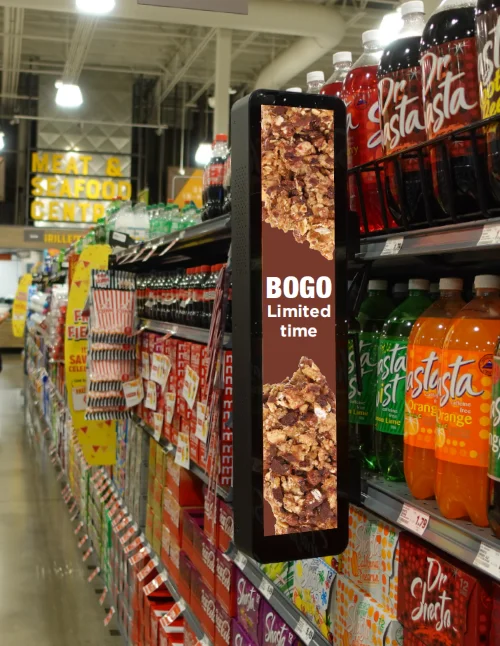
Quad’s in-store retail media network empowers brands to steer purchase decisions and build bigger baskets through innovative, well-placed digital messaging.
Scarcity creates urgency
Then another cue appears: Limited time.
Scarcity bias introduces urgency. The opportunity feels temporary, which can make delaying the decision feel like losing something.
Into the cart the granola bars go.
What began as a trip for orange juice has become an incremental purchase, influenced by digital signage, product placement, packaging imagery and behavioral cues along the shopper journey.
What influences consumer buying behavior in stores?
Your shopping trip may have felt casual, even automatic. But a complex combination of conscious and non-conscious factors influenced your behavior:
Individually, these factors may seem small. Together, they shape the in-store customer experience and influence what gets noticed, considered and purchased.
For marketers, the challenge is that shoppers aren’t always able to articulate these influences after the fact.
How pre-market testing and research can uncover non-conscious shopper behavior
Traditional consumer research often asks people what they remember, prefer or intend to purchase. Those answers are valuable — but they don’t always reveal the complete picture.
Eye tracking
Eye tracking research reveals where shoppers look, how quickly they notice something and how long it holds their attention.
In a retail environment, eye tracking can help marketers understand which packaging, displays, signs and other visual elements attract attention.
Heat maps
Heat maps visualize the intensity of shopper attention across packaging, signage, shelves or a competitive set.
They can reveal visual hotspots and cold zones, helping marketers identify areas that may require a design rethink before going to market.
In-context shelf testing
In-context shelf testing evaluates products in an environment that more closely resembles the conditions shoppers encounter in the real world.
Brands can test variables such as packaging design, shelf placement and competitive context to understand not simply whether consumers say they like something, but how they behave when surrounded by real-world distractions and choices.
Digital signage A/B testing
Digital signage A/B tests allow marketers to compare headlines, imagery, motion and other creative variables to determine what earns attention and encourages action.
Testing in context can reveal which creative elements get noticed and which get ignored.
Turn shopper psychology into better marketing decisions
The most important consumer purchase decisions don’t always begin with a conscious thought. A shopper sees. Reacts. Recognizes. Remembers. Hesitates. Trusts. Reaches. Understanding those moments can help marketers design packaging, retail media and in-store experiences around how people actually shop. Learn more about how Quad taps into non-conscious decision-making for brands and retailers, here.
About Quad
Quad (NYSE: QUAD) is a marketing experience, or MX, company that helps brands make direct consumer connections, from household to in-store to online. The company does this through its MX Solutions Suite, a comprehensive range of marketing and print services that seamlessly integrate creative, production and media solutions across online and offline channels. Supported by state-of-the-art technology and data-driven intelligence, Quad simplifies the complexities of marketing by removing friction wherever it occurs along the marketing journey. The company tailors its uniquely flexible, scalable and connected solutions to each client’s objectives, driving cost efficiencies, improving speed-to-market, strengthening marketing effectiveness and delivering value on client investments.
Quad employs approximately 10,000 people in 10 countries and serves approximately 2,100 clients including industry leading blue-chip companies that serve both businesses and consumers in multiple industry verticals, with a particular focus on commerce, including retail, consumer packaged goods, and direct-to-consumer; financial services; and health. Quad is ranked among the largest agency companies in the U.S. by Ad Age, buoyed by its full-service media agency, Rise, and creative agency, Betty. Quad is also one of the largest commercial printers in North America, according to Printing Impressions.
For more information about Quad, including its commitment to operating responsibly, intentional innovation and values-driven culture, visit quad.com.