

In brief: Postmaster General (PMG) David Steiner briefed the House Oversight Subcommittee on Government Operations on the current financial situation facing the USPS. The paper market continues to face pressure due to supply shortages for some grades and adverse weather. Transportation networks have been jolted by a spike in diesel prices due to the Middle East conflict just as trucking industry capacity is tightening. And supply chain issues related to the war are affecting everything from aluminum to the raw materials used in printing inks.
Built on our roots as a printer, mail industry partner and logistics leader, Quad is a marketing experience (MX) company focused on delivering streamlined solutions at scale to our clients. As the largest USPS customer, we are uniquely positioned to provide clients with best practices and insights on the latest postal, paper and logistics topics. If you have any questions or concerns during these challenging times for our industry, contact your Quad representative. We’ll tap our in-house experts to investigate and get you the answers you need.
PMG David Steiner warns Congress of a fast-approaching financial cliff for the Postal Service
Appearing before the House Oversight and Government Reform Committee’s Government Operations Subcommittee on March 17, PMG David Steiner testified that the USPS could face a financial crisis as soon as this fall.
To avoid that, as Government Executive reports, he asked lawmakers to consider easing the agency’s mandates and allowing the Postal Service more flexibility with pricing, investments and financial management.
“If you want the same number of delivery days and post offices, we can do that, but someone has to pay for it. If you want to have a discussion about reducing services, we can do that,” Steiner said. “But there’s one thing we can’t do, and that is the status quo, and we don’t have a lot of time.”
He said an “easy action” would be for lawmakers to increase the USPS statutory debt limit, echoing a request that has already been made by the USPS’s Board of Governors. (The debt cap, set at $15 billion, has not increased since 1992.)
Rep. Pete Sessions, R-Texas, the subcommittee’s chairman, emphasized that lawmakers would need more information before raising the debt limit. “Congress needs to have confidence not only that [the USPS will] be able to pay it back, but that they’re on the right road to achieve financial security,” he said.
During the hearing, Steiner maintained that the USPS has been saving money under the Delivering for America (DFA) plan introduced by his predecessor, Louis DeJoy. But some stakeholders, including members of Congress from both sides of the aisle, have criticized the plan for worsening mail performance without generating savings and called for it to end.
Industry groups object to USPS request to eliminate CPI cap
This month, the mail industry group PostCom and the Alliance for Nonprofit Mailers filed a response with the Postal Regulatory Commission (PRC) regarding the USPS request to either eliminate the Consumer Price Index (CPI) cap on rate increases or provide the agency with a rate reset that includes 23% banked authority to raise rates.
Their filing includes a report by the Elevated Insights Group (EIG), commissioned by PostCom and the Envelope Manufacturers Association (EMA), explaining why additional rate increases will not solve the USPS’s financial challenges. Industry groups have asked that the PRC file the EIG report as a library reference, which would put it officially “on the record” for the PRC to consider when making its decision.
Inflation rate for the USPS July price increase set
The final month of inflation data has been published for the USPS July price change; the official CPI number is 2.613%.
This accounts for both the final month of inflation data and the revised calculation that the USPS proposed to adjust for October, when no CPI number was published because of the government shutdown.
| July 2026 Postal Rate Budget Guidance as of March 13 — Ranges | |
|---|---|
| First-Class | 5.0% |
| Periodicals | 6.8% |
| Marketing Mail Letters | 5.7% |
| Marketing Mail Flats, carrier route, CART | 5.7% |
| Marketing Mail Flats, non-CART | 7.7% |
| Bound Printed Matter (BPM) | 4.8% |
Miscellaneous updates
USPS delivery performance
Here are the average in-home curves for our Marketing Mail clients who tracked their mail with Quad’s IMsight application over the four weeks specified. February’s performance reflected the effects of Winter Storms Gianna and Hernando (which came in the wake of Winter Storm Fern in late January). While some facilities experienced three- to four-day delays in processing and transportation, delivery performance recovered as the month progressed.
| Week of 2/9 | Week of 2/16 | Week of 2/23 | Week of 3/2 | |
|---|---|---|---|---|
| Early | 14% | 20% | 23% | 21% |
| Day 1 | 41% | 50% | 53% | 54% |
| Day 2 | 65% | 72% | 76% | 76% |
| Day 3 | 82% | 82% | 89% | 87% |
| Day 4 | 91% | 89% | 95% | 94% |
| 1 Day late | 93% | 91% | 96% | 95% |
The facilities below struggled to hit 70% in-home on average by USPS Service Standards for Flat mail. Letter mail moved accordingly across the country.
| Entry type | City | Percent in-home by Service Standard |
|---|---|---|
| SCF | Dayton, Ohio | 60% |
| SCF | Great Falls, Mont. | 60% |
USPS volume
| Mail volume for the week ended March 7, compared to last year |
||
|---|---|---|
| Total Mail Volume | Up 2.6% |
▲ |
| Packages | Up 0.1% |
▲ |
| Single Piece | Down 8.7% |
▼ |
| Presort First Class | Down 8.4% |
▼ |
| Marketing Mail | Up 2.5% |
▲ |
| Periodicals | Down 16.3% |
▼ |
| Mail volume for the week ended February 28, compared to last year |
||
|---|---|---|
| Total Mail Volume | Down 5.9% |
▼ |
| Packages | Down 7.1% |
▼ |
| Single Piece | Down 15.1% |
▼ |
| Presort First Class | Down 9.3% |
▼ |
| Marketing Mail | Up 3.4% |
▲ |
| Periodicals | Up 18.3% |
▲ |
| Mail volume for the week ended February 21, compared to last year |
||
|---|---|---|
| Total Mail Volume | Up 1.4% |
▲ |
| Packages | Down 1.2% |
▼ |
| Single Piece | Down 8.4% |
▼ |
| Presort First Class | Down 2.1% |
▼ |
| Marketing Mail | Up 2.7% |
▲ |
| Periodicals | Down 30.2% |
▼ |
| Mail volume for the week ended February 14, compared to last year |
||
|---|---|---|
| Total Mail Volume | Up 4.4% |
▲ |
| Packages | Up 8.5% |
▲ |
| Single Piece | Down 5.4% |
▼ |
| Presort First Class | Down 3.9% |
▼ |
| Marketing Mail | Up 6.8% |
▲ |
| Periodicals | Down 15.9% |
▼ |
Paper market
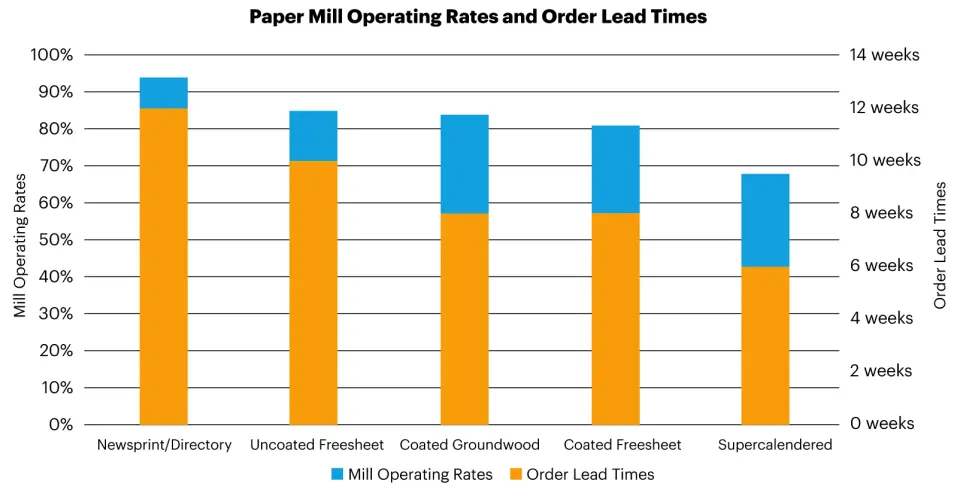
paper market continues to face pressure from supply shortages for some grades and adverse weather, affecting order lead times and Last Day to Change (LDC) windows. Lead times vary significantly based on the paper grade and market availability.
Logistics
As severe weather subsided, easing its grip on transportation networks, new challenges hit the logistics market.
As always, your Quad representative will work diligently to find you the lowest rates with the most efficient transportation available.